
You’ve been thinking about it for a while. Maybe you saw a video. Maybe a friend went on a surf trip and came back a slightly different person — calmer, browner, weirdly enthusiastic about wetsuits. Maybe you’ve just always wanted to try and never found the right moment.
Here’s the thing: there is no right moment. There’s just a coast, some waves and a decision to go. And if you’re going to learn to surf anywhere in Europe, northern Portugal is about as good as it gets.
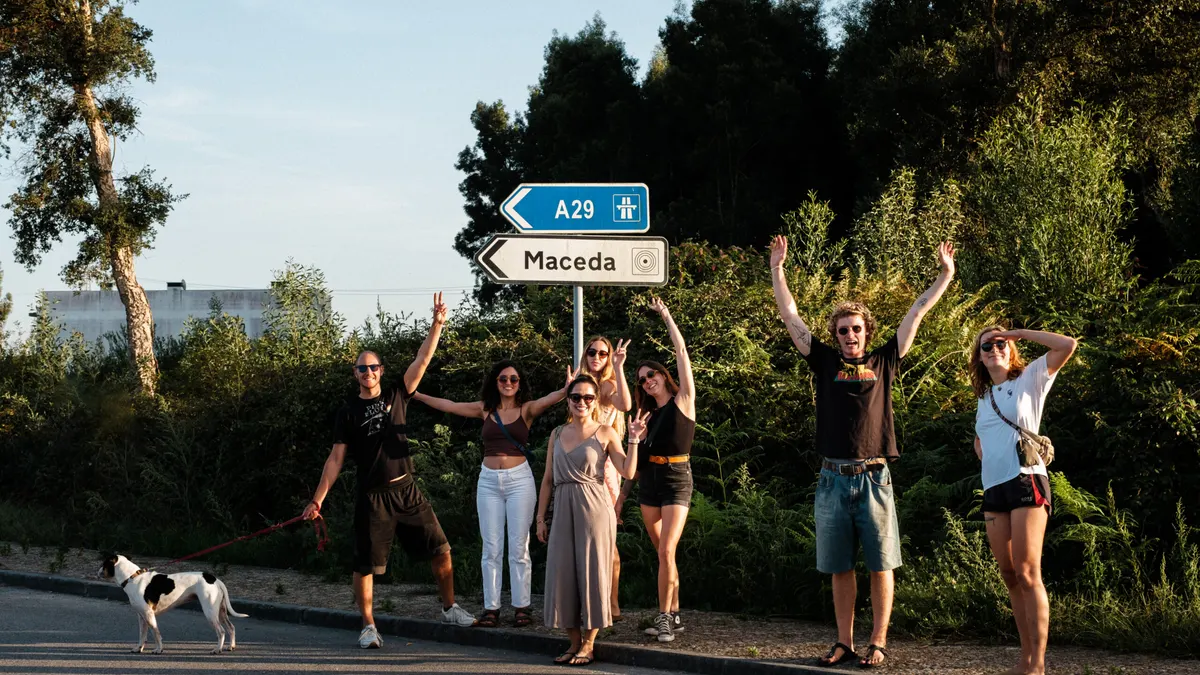
Most people’s mental map of Portuguese surfing jumps straight to Ericeira (World Surfing Reserve, professional competition waves, crowded lineups) or Nazaré (the giant wave that breaks the internet every winter). Those places are incredible, but they’re not where you want to be as a beginner. The stretch of coastline north of Porto — where Maceda Surf Camp sits — is another world entirely. Quieter, wilder, emptier, and built for people who are just starting out.
Here’s everything you need to know.
Why the north is where you want to learn
There are three reasons the north works so well for beginners, and they all connect to each other.
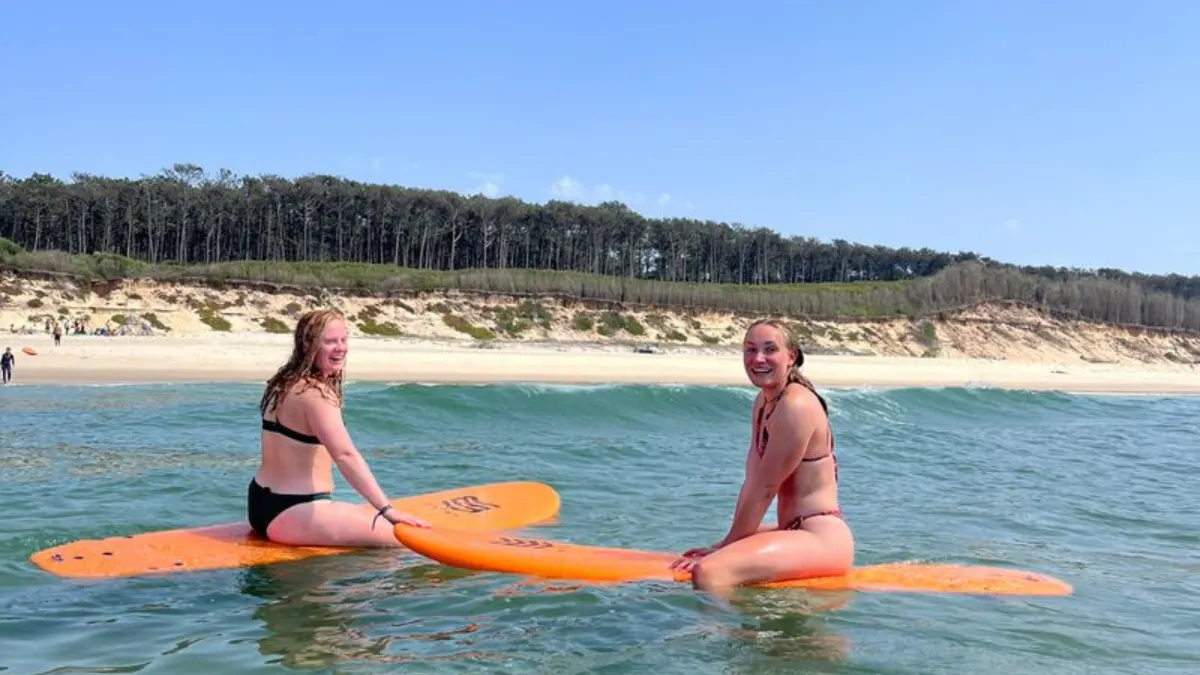
The first is the beaches themselves. Northern Portugal’s coast is almost entirely sand — long, wide, gently sloping beaches with no rocks, no reef, no sea urchins. When you wipe out (and you will, a lot — everybody does), you land on sand. This sounds like a small thing until you’ve watched someone learning on a reef break in Ericeira, nervously eyeing the rocks every time they fall. Learning should feel fun, not stressful. Sandy beaches take the fear out of the equation.
The second is the waves. The north picks up Atlantic swell consistently, but the beach breaks here produce gentler, more predictable waves than the powerful swells further south. You get enough push to learn on — enough energy in the whitewater to carry you to the beach — without getting thrown around by waves that are beyond your ability. The ocean here is firm but fair. It’ll challenge you without punishing you.
The third, and honestly the most important, is the space. Crowded lineups are the enemy of learning. When there are twenty people on every peak, beginners feel anxious, get in the way, catch fewer waves, and have a worse time. At Maceda Beach on a weekday, you might share the water with three other people. That’s not an exaggeration. The emptiness of the lineups in northern Portugal changes everything about the learning experience. You paddle out, catch waves, make mistakes, try again — and nobody is watching, nobody is waiting, nobody cares. It’s just you and the ocean working it out together.
Add in affordable prices (Portugal is still one of the cheapest surf destinations in Western Europe), incredible food (grilled fish, vinho verde, pastéis de nata — even the airport food is good), and easy access from Porto airport (Ryanair, easyJet and TAP fly in from most European cities, often for under €50 each way), and the case is hard to argue with.
The best beaches for beginner surfers
Maceda Beach
This is our home break, so we’re biased — but not wrong. Maceda Beach (officially Praia de São Pedro de Maceda) stretches about 3.5 kilometres of white sand, backed by maritime pine forest and dunes, with no buildings, no beach bars, and no development of any kind. The water is clean, the bottom is sandy everywhere, and the whitewater is gentle enough for complete beginners while offering enough shape for improvers to start reading waves.
What really makes Maceda special for learning is the space. There’s so much beach that you never feel crowded, even in summer. Our instructors can spread students out along the shoreline, each working on their own peak, with room to fall and recover without worrying about colliding with someone else. It’s the kind of environment where learning actually feels like play — which, when you think about it, is what surfing is supposed to be.
This is where we run our surf lessons. You’ll get to know this beach well during your stay.
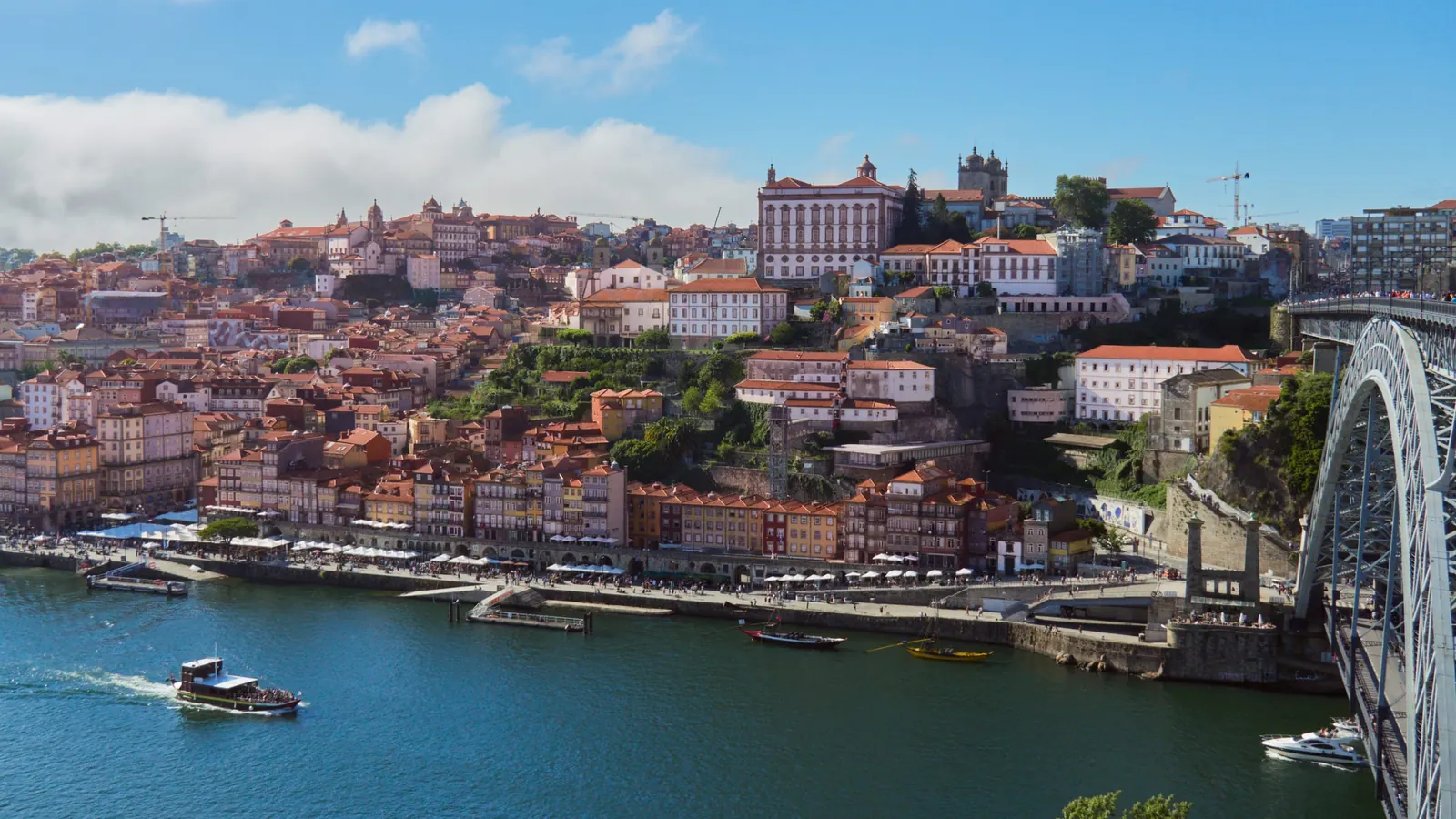
Matosinhos
The go-to beginner beach in the Porto area, and the only surf break in Portugal you can reach by subway. Matosinhos sits right at the edge of the city, with surf schools lining the promenade, sandy bottom, and small rolling waves that are ideal for first-timers.
The catch? It gets busy. On a sunny summer weekend, Matosinhos is packed — surfers, bodyboarders, swimmers, sunbathers, people eating ice cream, and the occasional lost tourist with a selfie stick. For a one-off lesson during a Porto city break, it works fine. For a proper multi-day learning experience, you’ll want somewhere with more room to breathe.
The seafood restaurants along the waterfront, though, are non-negotiable. After surfing, walk to any of the grilled fish places, order a robalo (sea bass) or dourada (sea bream) with salad and potatoes, and spend €10–15 on one of the best meals of your life. This is not an optional part of the surf trip.
Cortegaça
Just south of Maceda, Cortegaça is another long beach break that picks up swell beautifully. (Read more about all five spots in our guide to surfing around Porto.) The waves here tend to be slightly more powerful than Maceda — a nice step up once you’ve got the basics down and want to feel a bit more push. The beach is backed by dunes and forest, the traditional fishing boats are still scattered along the sand, and the whole place has a character that more developed beaches lost a long time ago. Cortegaça has a proud fishing heritage: the “Arte Xávega” drag-net technique, once powered by oxen, was practised on this beach for centuries.
Esmoriz
Further south again, past Cortegaça, Esmoriz produces hollower, faster waves when the sandbars align — which makes it better suited to improvers and intermediates. On a small day, though, it can be fun for confident beginners looking for something with a bit more speed. Behind the beach sits the Barrinha de Esmoriz, a freshwater coastal lagoon and nature reserve that’s worth exploring on a flat day (or any day, honestly — it’s beautiful and barely anyone knows about it).
What the water is actually like
Let’s be straight: northern Portugal is not Bali. The Atlantic is cold. Not unbearably cold, not dangerously cold, but cold enough that you’ll want a wetsuit every time you paddle out, even in August.
Here’s the reality, month by month. In winter — December through February — the water sits around 13–14°C. That’s proper cold. You’ll want a 4/3mm wetsuit, neoprene boots, and maybe gloves on the harshest days. The air temperature hovers between 8 and 15°C. Getting changed in the car park is character-building. But the waves are the best of the year, the beaches are empty, and there’s something genuinely thrilling about surfing the Atlantic in winter with nobody else around.
Spring — March through May — brings a slow thaw. Water creeps up to 14–16°C, the days get longer, the light turns golden, and a 4/3mm wetsuit handles everything comfortably. By late May, some people switch to a 3/2mm. Spring is quietly one of the best times to visit: the swell is still active, the weather is improving, and the summer crowds haven’t arrived yet.
Summer — June through September — is when most beginners visit, and for good reason. The water reaches 17–20°C (17°C is still cold by Mediterranean standards, but a 3/2mm wetsuit makes it completely comfortable). Air temperatures climb to 20–30°C. The waves are smaller and friendlier. The downside is that an interesting phenomenon called upwelling can occasionally make the water colder in July than in May — deep, cold water rises to the surface on certain wind patterns, and you’ll get out expecting a warm sea and find 15°C instead. It’s temporary, but it’s a good reason to always bring a decent wetsuit to the north, even in high summer.
Autumn — September through November — is what many locals consider the best season of all. The water is still warm from summer (16–19°C), the first proper swells of the season start rolling in, the light is extraordinary, and the tourists have gone home. September and October in northern Portugal are genuinely magical. If you can choose your dates, this is where we’d steer you. (We wrote a full season-by-season guide if you want the details.)
If you’re staying at a surf camp, wetsuits are almost always included. Don’t buy one just for a week’s trip.
What happens in your first surf lesson
If you’ve never surfed before, you’re probably imagining the moment you stand up on a wave and ride it to the beach. That moment might happen on your first day. It might take three sessions. Either way, here’s what the process actually looks like.
It starts on the beach. Your instructor spends 30 to 40 minutes on the sand, teaching you the fundamentals: how to lie on the board correctly (further forward than you think), how to paddle efficiently (not thrashing — smooth, deep strokes), how to read the whitewater so you can time your waves, and how to do the pop-up — the movement that takes you from lying flat to standing.
The pop-up practice on the beach feels silly. You’re lying on the sand, popping up to your feet over and over, while tourists walk past and pretend not to stare. Embrace the silliness. This is the single most important part of the lesson, because the muscle memory you build here is what your body will fall back on when you’re in the water and the wave is pushing you and your brain is screaming “STAND UP NOW.” If you skip the sand work, you’ll spend the water session floundering. Every good surf school spends time on this. If a school rushes you into the water without beach practice, that’s a red flag.
Then you head into the ocean. You start in the whitewater — the foam after the wave has already broken. It’s chest-deep, the waves are rolling gently towards the beach, and your instructor is right next to you, pushing your board into waves and giving real-time coaching. You catch your first wave on your belly. Then your knees. Then, if your body remembers the pop-up from the beach, you stand.
The feeling when you stand up for the first time is difficult to describe and impossible to forget. The world simplifies. It’s just you, the board, the water moving underneath you, and a kind of grinning, disbelieving joy that you were not expecting to feel. It lasts about four seconds. You fall. You come up laughing. You paddle back out immediately, because you need to feel that again.
Most beginners stand up within their first session. Some take two or three tries. Both are completely normal. The ocean doesn’t care about your ego, your fitness level, or how good you are at other sports — and that’s part of why surfing is so addictive. It meets you exactly where you are.
How long does it actually take to learn?
There’s a difference between “standing up on a whitewater wave” (one session) and “actually surfing” (longer). Standing up in the foam is the first milestone, and most people hit it on day one. Catching and riding green (unbroken) waves — paddling out beyond the break, reading the ocean, positioning yourself on the right peak, catching the wave at the right moment, popping up, and riding it with some control — usually takes five to ten sessions spread over one or two weeks.
A week at a surf camp, with daily lessons and constant practice, will fast-track your progression more than months of occasional weekend sessions. Your body adapts. Your paddle fitness builds. Your eye starts reading the waves. The repetition cements the basics until they’re instinct rather than thought. By the end of a week, you won’t be surfing like a local — but you’ll be comfortable in the ocean, confident on a board, and genuinely hooked.
That’s the honest truth about learning to surf: the curve is steep at the start, incredibly rewarding in the middle, and infinite at the top. Nobody ever finishes learning. The ocean keeps changing, and you keep adapting. That’s what keeps people coming back for decades.
Why a surf camp beats organising everything yourself
You could book a hotel in Porto, find a surf school online, rent equipment separately, figure out which beach to go to, arrange transport, and piece together a surf trip from individual parts. It would work. But you’d miss the point.
A surf camp — the good ones, at least — wraps the whole experience together in a way that makes learning faster and the trip richer. At Maceda Surf Camp, you get daily lessons with the same instructors who get to know your level and weaknesses, equipment that’s already there when you wake up, transport to whichever beach is working best that morning (our instructors check the forecast and conditions every day), yoga sessions that undo the muscle tightness from paddling, communal breakfasts, and a social atmosphere that turns strangers into friends.
There’s also something about immersion that accelerates learning. When you eat dinner with other surfers, talk about the waves, watch video of your session, compare notes on what worked and what didn’t, and then wake up and do it all again — the learning compounds. You absorb the culture of surfing, not just the mechanics. You start to understand the ocean as a place you belong in, not just a gym with waves.
Most of our guests come alone. By the second evening, they know everyone’s name. By the third day, they have inside jokes. By the end of the week, they’re exchanging numbers and planning return trips together. A hotel can’t do that.
The north vs the south: a quick comparison
The Algarve has warmer water, more sheltered breaks and more reliable sunshine. If guaranteed warmth matters more to you than empty lineups, the south is a reasonable choice — particularly for families with small children who want 22°C water and don’t want to wrangle a wriggling kid into a thick wetsuit.
Ericeira and Peniche, in central Portugal, are the country’s surf heartland. The wave quality is exceptional — Ericeira is a World Surfing Reserve, Peniche hosts the WSL Championship Tour. But these are crowded, established surf areas with lineups that can feel competitive and prices that reflect their popularity.
Northern Portugal offers something different: empty waves, wild nature, authentic culture that hasn’t been packaged for tourists, and a coast that still feels like a secret. The waves are consistent, the beaches are sandy, the pine forests are beautiful, Porto is on your doorstep, and the whole experience costs significantly less. The water’s colder, yes. But you’re in a wetsuit anyway — and the tradeoff is having the ocean to yourself.
Most surfers who visit the north tell us the same thing: “I had no idea this existed.” Now you do.
Things beginners always want to know
Do I need to be fit? Not especially. Surfing is physical, and your first session will leave you more tired than you expected — paddling uses muscles you didn’t know existed, and the ocean is constantly moving, which means your body is constantly stabilising. But a basic level of fitness is enough to get started. Your body adapts quickly if you’re surfing every day, and by mid-week you’ll feel like a different person in the water.
Can I learn at any age? Yes. We’ve taught people from six to sixty-five. Children pick it up fast because they’re fearless and flexible. Teenagers learn fastest of all (low body weight, high confidence, zero overthinking). Adults take slightly longer but bring focus and patience. There is genuinely no age limit on catching your first wave.
Is it dangerous? Like any ocean sport, there’s inherent risk. Rip currents, other surfers’ boards, the rare big set that catches you off guard. But learning on sandy beaches with qualified instructors, in small groups, in manageable conditions, minimises that risk to a level comparable with swimming or cycling. We brief everyone on ocean safety before every session — how to identify rip currents, how to fall safely, how to handle your board around other people.
What if it’s flat? Rare in northern Portugal, but it happens, usually for a day or two in mid-summer. If the waves aren’t cooperating, we’ll either find a sheltered spot that’s still working (the advantage of having local knowledge) or switch to another activity — yoga, a hike through the forest reserve, a day trip to Porto, or surfskate practice in the camp.
What should I bring? Swimwear, reef-safe sunscreen (SPF 50 — the Portuguese sun is stronger than it looks, especially reflected off the water), a towel, and whatever clothes you’d wear for a casual outdoor week. We provide boards, wetsuits, transport and everything you need for the lessons. Pack light layers for evenings — the coast cools down after sunset, even in summer. That’s it. Keep it simple.
Northern Portugal is one of Europe’s last proper surf secrets. Empty waves, wild forest, warm people, incredible food, and a coastline that reminds you what the world looked like before everyone tried to monetise it. If you’ve been thinking about learning to surf — actually thinking about it, not just liking Instagram reels about it — this is the place to do it. And the best time is whenever you’re ready.